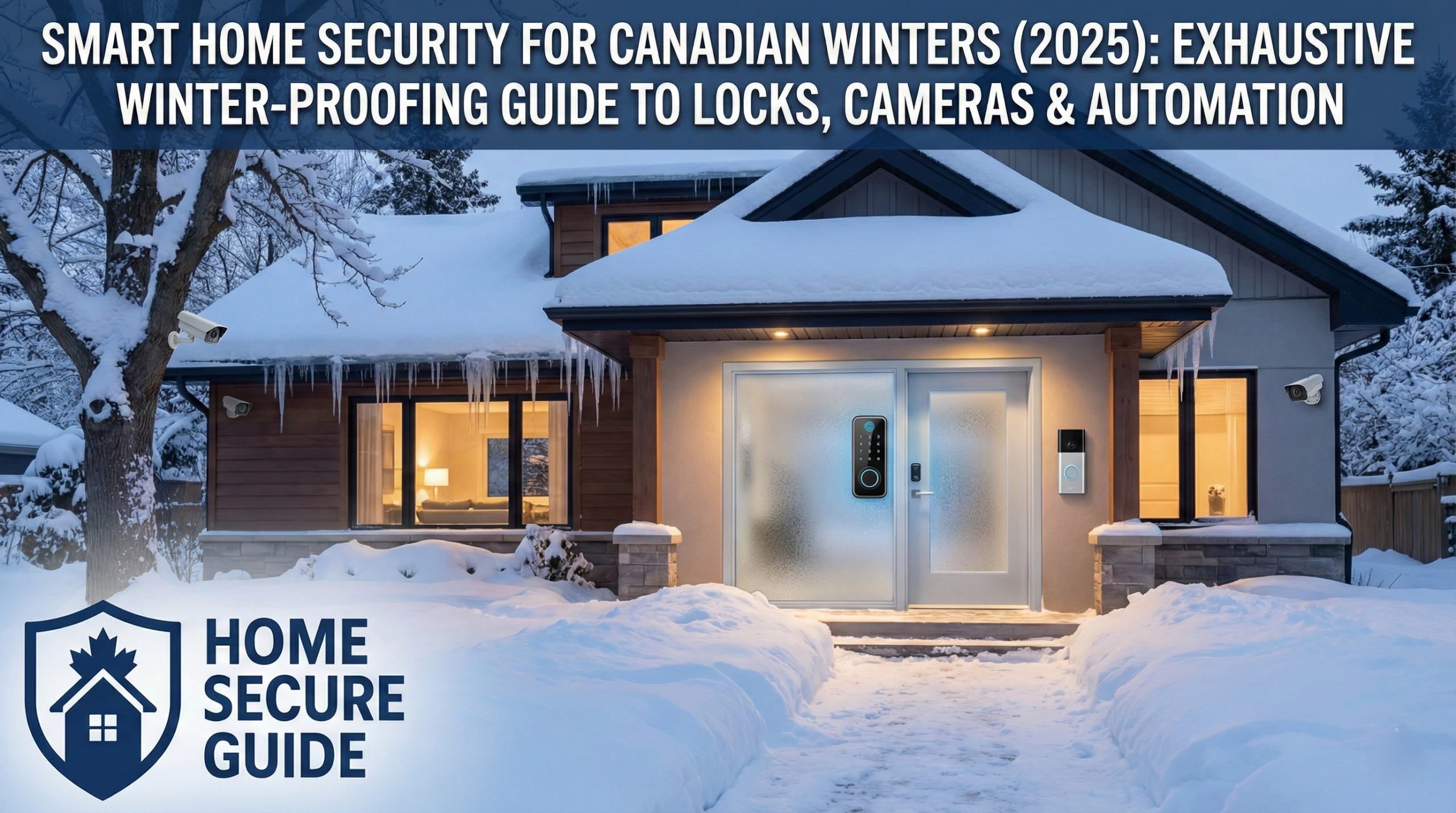
Smart Home Security for Canadian Winters (2025): Exhaustive Winter-Proofing Guide to Locks, Cameras & Automation
Executive Summary
The proliferation of smart home technology in the 21st century has largely been driven by innovation centers located in temperate climates—Silicon Valley, Shenzhen, and Tel Aviv. Consequently, the default engineering assumptions for consumer automation devices often fail to account for the thermal and meteorological extremes characteristic of the Canadian market. As of late 2025, Canadian homeowners face a distinct set of challenges: identifying hardware that can survive sustained temperatures below -30°C, managing battery chemistry that degrades rapidly in the cold, and ensuring connectivity through dense structural materials insulated against winter heat loss.
This report provides a deep-dive analysis of the current smart home landscape, specifically tailored to the “Harsh Canadian Winter” niche. We have scrutinized the latest product launches as of late 2024 and early 2025, including the Aqara U200/U300 series, Reolink’s 16MP panoramic cameras, Lorex’s industrial-grade consumer lines, and the evolving Matter-over-Thread ecosystem.
The research indicates a definitive schism in product reliability. While wireless, battery-operated devices offer installation convenience, they represent a significant liability in Canadian winters due to the “charging lockout” phenomenon inherent in lithium-ion chemistry. Conversely, the market has seen a maturation of “retrofit” smart locks and Power over Ethernet (PoE) cameras that leverage the home’s thermal envelope to protect critical components. This report establishes that for the Canadian consumer, reliability is not a function of software features, but of thermodynamic engineering.
Disclosure: As an Amazon Associate, we earn from qualifying purchases—at no extra cost to you. Our recommendations are based on thorough research and Canadian homeowner needs, and commissions never influence our reviews
The Canadian Variable: Meteorological Challenges to Consumer Electronics
To successfully select smart home automation for Canada, one must first understand the specific failure modes induced by the climate. It is not sufficient for a device to be “water resistant”; it must resist the specific behaviors of water and electricity at sub-zero temperatures.
Thermal Contraction and Ingress Protection Dynamics
Most consumer electronics carry an IP (Ingress Protection) rating, typically IP65 or IP66. The first digit (6) indicates the device is dust-tight. The second digit (5 or 6) indicates resistance to water jets. However, these ratings are certified at standard laboratory temperatures (typically 20°C).
In the Canadian context, the primary threat is thermal contraction. As ambient temperatures drop from 10°C to -30°C, different materials contract at different rates. The aluminum housing of a camera, the glass lens cover, and the rubber gaskets sealing them shrink by varying degrees.
- Seal Failure: If the rubber gasket contracts more than the metal housing, or becomes brittle and loses its elasticity (a common property of cheap elastomers), the seal is compromised.
- The Freeze-Thaw Vacuum: When a device heats up (due to internal electronics or sunlight) and then rapidly cools at night, the air inside contracts, creating a partial vacuum. If the seals are imperfect, moist air is drawn inside. When the device cools further, this moisture condenses and freezes on the circuit board or the inside of the lens.
- Market Implication: Devices with retrofit designs (like the Aqara U200) or fully sealed industrial housings (like the Lorex Nocturnal series) show markedly lower failure rates because the critical seals are either interior to the home or engineered with industrial tolerances.
The Electro-Chemical Limitations of Batteries
The “wireless” revolution is the greatest marketing success and the greatest engineering failure of the smart home industry regarding cold climates. The physics of Lithium-Ion (Li-ion) batteries creates an insurmountable barrier for reliable winter operation in Canada.
The Voltage Sag Phenomenon
Standard Li-ion batteries rely on the movement of lithium ions between the cathode and anode through an electrolyte solution. As temperatures drop, this electrolyte becomes viscous.
- Internal Resistance: This viscosity increases the internal resistance of the battery. When the device tries to draw power (e.g., a smart lock motor engaging to throw a deadbolt), the voltage drops precipitously.
- False Empty Readings: A battery might have 60% chemical energy remaining, but at -20°C, the voltage sag under load makes the device believe the battery is empty, triggering a shutdown. This is why smart locks like the Lockly Visage or Ultraloq Bolt may simply die during a cold snap, only to “recover” when the battery is warmed up.
The Charging Lockout (Solar Failure)
A critical, often unadvertised feature of Battery Management Systems (BMS) in modern devices (such as Nest Doorbell Battery, Reolink Altas, EufyCam S3) is the low-temperature charging cutoff.
- Mechanism: Charging a Li-ion battery below 0°C (32°F) causes lithium plating metallic lithium builds up on the anode instead of intercalating into it. This permanent damage can lead to internal short circuits and fires.
- The Result: To prevent this, the BMS physically disconnects the charging circuit when the temperature is below freezing.
- The Solar Myth: Consumers in Canada are often sold “Solar Panels” for their security cameras. In December, January, and February—when surveillance is most needed due to long nights, the ambient temperature in many Canadian regions rarely rises above 0°C. Consequently, solar panels are functionally useless for huge portions of the winter. The camera will run off its battery until it dies, at which point the user must climb a ladder, remove the unit, and bring it inside to charge.
Optical Obstruction: Snow, Ice, and Glare
Winter introduces unique optical challenges for security cameras and video doorbells.
- IR Reflection (Snow Blindness): The infrared (IR) LEDs used for night vision reflect intensely off falling snowflakes. This creates a “blizzard” effect on the video feed, where the camera focuses on the bright, near-field snow rather than the dark background, rendering the footage useless.
- Lens Icing: Without an internal heater, the lens surface can become colder than the ambient air due to radiative cooling on clear nights. This promotes frost formation. PoE cameras often generate enough waste heat (10-15 Watts) to keep the lens clear, whereas battery cameras (using milliwatts) do not.
Smart Entry Systems: Deadbolts and Levers
The smart lock market has segmented into two distinct categories: Integrated Locks (replacing the entire deadbolt assembly) and Retrofit Locks (replacing only the interior thumbturn). For the Canadian market, this distinction is the single most important factor in reliability.
The Retrofit Advantage: Aqara U200
The Aqara U200 Smart Lock represents a paradigm shift ideal for cold climates.
- Architecture: The U200 mounts over the existing deadbolt thumbturn on the inside of the door. The exterior component is merely a wireless keypad/fingerprint reader.
- Thermodynamic Benefit: The sensitive components – the motor, the battery (rechargeable Li-ion), and the main logic board remain inside the home’s thermal envelope (approx. 20°C). They are never exposed to the -30°C exterior.
- Cold Weather Performance: Because the battery is warm, it suffers no voltage sag. Because the motor is warm, the grease does not thicken. The exterior keypad is rated IPX5 and functions from -15°C to 66°C, but since it has no moving parts or heavy power draw, its reliability in extreme cold is far superior to integrated locks.
- User Verification: Reports from users in Edmonton and Norway confirm the U200 operates flawlessly in temperatures where integrated locks fail.
- Connectivity: It supports Matter over Thread, allowing seamless integration into Apple Home, Google Home, and Home Assistant without a proprietary hub.
The Modular Workhorse: Yale Assure Lock 2
For homeowners preferring a complete deadbolt replacement, the Yale Assure Lock 2 remains the gold standard for reliability, though it requires specific configuration for winter.
- Temperature Rating: The exterior assembly is rated to -30°C (-22°F), one of the lowest official ratings in the consumer market.
- Power Source: It uses 4 AA batteries. Crucially, Yale allows for the use of Energizer Ultimate Lithium batteries. Unlike alkaline batteries which fail at freezing, lithium primaries function down to -40°C.
- Modular Connectivity: The “Smart Module” is swappable. Canadian users should opt for the Z-Wave or Matter modules over the Wi-Fi module. Wi-Fi radios consume significantly more power (400mA vs 40mA), which accelerates battery death in cold weather.
- Keyway Importance: We strongly recommend the Keyed model (YRD420) over the Key-Free (YRD410). In the event of a total electronic failure during a polar vortex, a physical key is the only 100% fail-safe.
Biometric Risks and Rewards: Lockly Visage & Eufy E330
The Lockly Visage Zeno and Eufy Video Smart Lock E330 offer futuristic features like facial recognition and integrated cameras, but they carry higher risks.
Lockly Visage Zeno:
- Pros: Native Apple HomeKey support allows users to unlock the door by tapping an iPhone or Apple Watch, which is much easier than fumbling for keys with frozen hands. The facial recognition is binocular and fast.
- Cons: The operating floor is -20°C (-4°F). User reports indicate that in temperatures below this (common in the Prairies), the lock can die completely, requiring a battery reseat to revive it. The reliance on a rechargeable battery pack means charging issues in extreme cold are possible.
Eufy E330:
- Pros: Combines a 2K camera, doorbell, and lock in one device, reducing installation clutter.
- Cons: Rated to -30°C , which is robust. However, users report the camera lens can freeze or fog up, and the unit may go offline in deep freeze (-20°C) due to power fluctuations. If the single device fails, you lose both your lock and your doorbell.
The Lever Lock Revolution: Aqara U300
Released in late 2024, the Aqara U300 fills a massive gap in the market: a smart lock for lever handles (side doors, garage entries) that supports Matter and HomeKey.
- Specs: Rated from -30°C to 55°C, matching the Yale Assure for cold tolerance.
- Utility: This is the ideal lock for a detached garage or side entry. It can be used in “Passage Mode” for easy access during the day and auto-lock at night.
- Connectivity: Native Thread support means excellent battery life (up to 8-10 months), provided a Thread Border Router is within range.
Power Source Analysis: Thread vs. Wi-Fi
The choice of protocol is a battery life decision.
- Wi-Fi Locks (e.g., Schlage Encode, Yale Wi-Fi): The lock must maintain a connection to the router. If the door is thick (steel/wood core) or far from the router, the radio transmits at max power, draining batteries in weeks during winter.
- Thread/Matter Locks (e.g., Aqara U300, Ultraloq Bolt Matter): The lock communicates with the nearest “router node” (like a smart plug or light switch) which acts as a relay. This short-range transmission uses a fraction of the energy, preserving battery capacity for the motor.
- Recommendation: For Canada, Thread is the superior protocol.
Perimeter Surveillance: Outdoor Cameras
The surveillance market is flooded with “wire-free” options that are fundamentally unsuited for the Canadian winter. The data is clear: if you want reliability in January, you must run a wire.
The PoE Mandate: Why Wireless Fails
Power over Ethernet (PoE) cameras receive both data and power through a single Cat5e/Cat6 cable.
- Thermal Physics: A PoE camera typically draws 5-12 Watts of power. This energy is dissipated as heat by the processor and image sensor. In a sealed housing, this self-heating effect can raise the internal temperature by 10-15°C above ambient.
- The Result: A PoE camera rated for -10°C will often continue working at -30°C because its internals are actually at -15°C. Battery cameras, which sleep most of the time to save power, generate no heat and are fully exposed to the ambient freeze.
- Battery/Solar Failure: As established in section 1.2.2, battery cameras like the Reolink Altas or EufyCam 3 will stop charging below freezing. Users must manually recharge them, a dangerous and annoying task in icy conditions.
Panoramic Monitoring: Reolink Duo 3 PoE
The Reolink Duo 3 PoE is a standout product for 2025, specifically for Canadian driveways and yards.
- Technology: It uses two lenses stitched together to create a 180° panoramic view without the distortion of a fisheye lens.
- Winter Benefit: One camera covers the entire front of a house. This reduces the number of devices to maintain.
- Resolution: 16MP (7680×2160), providing incredible detail for identifying license plates or faces even at a distance.
- Cold Tolerance: While the spec sheet lists -10°C, widespread user reports confirm operation down to -40°C due to the PoE self-heating effect. It is IP67 rated, making it submersible and impervious to melting snow.
Canadian Durability: Lorex 4K Nocturnal Series
Lorex, headquartered in Markham, Ontario, designs cameras with local conditions in mind. The Nocturnal Series (e.g., LNE9383/9393) is the heavy-duty choice.
- Specs: Rated officially to -30°C and -40°C depending on the model.
- Build: All-aluminum chassis with IP67 waterproofing.
- Optics: Motorized varifocal lenses allow the user to optical zoom (not digital) to frame the driveway perfectly. This is crucial in winter; a wider angle than necessary will just capture piles of snow which reflect IR light and darken the image.
- Night Vision: Long-range IR (150ft) is powerful enough to punch through light snowfall, though Color Night Vision requires ambient light.
The Aesthetic Choice: Ubiquiti G5 Turret Ultra
For users invested in the UniFi ecosystem, the G5 Turret Ultra offers a compact, discreet form factor.
- Form Factor: The “Turret” design is superior to the “Bullet” design for snowy regions. Bullet cameras have a protruding “shelf” (the sunshield) where snow and icicles can accumulate, blocking the lens. Turrets are flush balls where snow tends to slide off.
- Specs: Rated to -30°C (-22°F).
- Performance: Excellent 2K resolution and AI detection for people and vehicles, which helps filter out motion triggers caused by blowing snow.
Battery/Solar: Examining the Reolink Altas PT Ultra
If running a cable is truly impossible, the Reolink Altas PT Ultra is the current market leader for battery/solar, but caveats apply.
- Battery: It houses a massive 20,000mAh battery, theoretically offering “continuous recording” for days.
- Winter Reality: In Canada, “continuous recording” is not viable in winter. The battery will drain in 4-8 days at -10°C if recording continuously. Users must switch to motion-only recording to survive the winter.
- The Charging Gap: You must accept that from December to March, the solar panel will likely not charge the device. You will need to bring the camera inside to charge via USB-C at least 2-3 times per winter.
The Front Line: Video Doorbells
The video doorbell is the most frequently interacted-with smart device. A frozen doorbell that doesn’t ring is a major inconvenience.
The Battery Bottleneck
Legacy battery doorbells (Ring, older Nest) are notorious for failing in Canada. The Nest Doorbell (Battery) has a hard cutoff at -20°C where it shuts down completely to protect the chemistry. This is unacceptable for a security device.
Reolink Video Doorbell (PoE / Wi-Fi Wired)
The Reolink Video Doorbell is widely considered the best reliable option for cold climates in 2025.
- Power: It has no battery. It runs strictly off PoE or the existing doorbell wiring (16-24V AC) plus Wi-Fi.
- Cold Performance: Because it constantly draws power to run the camera and Wi-Fi radio, the unit stays warm. Users report flawless operation at -35°C despite a conservative -10°C spec rating.
- Pre-Roll: The PoE version records the 6 seconds before a motion event, ensuring you see the approach, not just the back of the delivery driver’s head.
Ubiquiti G4 Doorbell Pro
- Specs: Rated to -30°C when used with the PoE adapter.
- Dual Cameras: It features a main camera and a downward-facing package camera. This is incredibly useful for verifying if a package is hidden behind a snowbank or exposed to the elements.
- Display Risk: The integrated LCD screen may experience slow refresh rates (ghosting) in extreme cold, but the camera and button functions generally remain operational due to internal heat.
Aqara G4 Video Doorbell
A unique hybrid option that is highly effective for Apple Home users.
- Architecture: Like the U200 lock, the G4 has a split design. The chime/repeater is inside (plugged in via USB-C), and the doorbell unit is outside.
- Power: It can run on AA batteries or wired power. It must be wired for Canadian winter use. When wired, the low-temp limit of the batteries is irrelevant.
- Face Recognition: Includes local facial recognition that runs on-device, triggering specific automations (e.g., “Unlock Aqara U200 when Dad is seen”).
Protocols and Infrastructure
Building a winter-resilient smart home requires more than just buying the right endpoints; it requires a robust network infrastructure.
Matter over Thread: A Cold Weather Savior?
The rollout of Matter over Thread in 2024/2025 is a significant development for Canadian smart homes.
- Battery Efficiency: Thread is a low-power mesh protocol. Devices sleep longer and wake faster than Wi-Fi devices. For battery-powered locks like the Aqara U300, this efficiency can mean the difference between the batteries lasting through the winter or failing in February.
- Self-Healing Mesh: If one node fails (e.g., a smart bulb burns out), the data routes through another node. This reliability is key during storms when power fluctuations might reboot devices.
Hub Placement and Signal Propagation
- The Problem: Exterior walls in Canada are thick, often containing vapor barriers, insulation, and brick or siding. These materials attenuate (weaken) Wi-Fi and Bluetooth signals.
- The Solution: Place your Thread Border Router (Apple TV 4K, HomePod Mini, Aqara M3 Hub) or Wi-Fi Access Point as close to the front door as possible—ideally in the entrance hallway.
- Signal Strength = Battery Life: A device with a weak signal will repeatedly retry transmissions at maximum power, draining its battery. A strong signal allows for low-power transmission, preserving the battery for the cold.
Installation and Winterization Techniques
Even the best hardware will fail if installed poorly. The following “best practices” are derived from professional installer feedback in cold zones.
Dielectric Grease and Drip Loops
- Corrosion: Salt spray (from road salting) and condensation can corrode electrical contacts. Apply dielectric grease to the Ethernet ports and power terminals of outdoor cameras before sealing them.
- Drip Loops: Always create a “U” shape with the cable before it enters the wall. This ensures water drips off the bottom of the loop rather than running down the cable and into the camera or the wall penetration.
Battery Chemistry Management
- Lithium Primaries: For devices that must use AA batteries (Yale Assure, Ultraloq), use Energizer Ultimate Lithium (L91). These cells use a Lithium/Iron Disulfide chemistry that performs consistently down to -40°C.
- Avoid Alkaline: Never use alkaline batteries in an outdoor smart lock in Canada. They will freeze, causing voltage drop-outs, and they risk leaking corrosive electrolyte into the lock mechanism.
Heated Enclosures (DIY)
For extreme northern applications (Zone 1/2), standard cameras may not suffice.
- DIY Heaters: Enthusiasts have successfully used 12V ceramic heating elements (connected to a simple thermostat) inside a dummy camera housing to keep a standard Wyze or Eufy camera warm. However, this voids warranties and requires electrical competence.
- Commercial Housings: Products like the Dotworkz enclosures provide heated/blown environments for cameras, but at a high cost.
Comparative Technical Analysis
Smart Lock Winter Specifications
| Model | Lock Type | Operating Temp (Low) | Power Source | Best Protocol | Winter Reliability Score |
| Aqara U200 | Retrofit | -15°C (Keypad Only)* | Rechargeable Li-ion (Indoor) | Thread | A+ |
| Yale Assure 2 | Deadbolt | -30°C (-22°F) | 4x AA (Lithium Compat.) | Z-Wave / Matter | A |
| Aqara U300 | Lever | -30°C (-22°F) | 4x AA | Thread | A |
| Lockly Visage | Deadbolt | -20°C (-4°F) | Rechargeable Li-ion | Wi-Fi | B- |
| Ultraloq Bolt | Deadbolt | -20°C (-4°F) | 8x AA | Matter/Thread | B |
| Eufy E330 | Combo | -30°C (-22°F) | Rechargeable Li-ion | Wi-Fi | B |
*Note: The Aqara U200’s critical components are indoors, making the effective low temp much lower than the keypad rating.
Outdoor Camera & Doorbell Winter Specifications
| Model | Type | Operating Temp (Low) | Power | Heater/Self-Heat | Winter Reliability Score |
| Lorex Nocturnal | Camera | -30°C / -40°C | PoE | Industrial Housing | A+ |
| Reolink Duo 3 | Camera | -10°C (User -40°C) | PoE | Self-Heating | A |
| Reolink Doorbell | Doorbell | -10°C (User -30°C) | PoE/Wired | Self-Heating | A |
| Ubiquiti G5 | Camera | -30°C (-22°F) | PoE | Self-Heating | A |
| Reolink Altas | Camera | -10°C | Battery/Solar | None (Charging Lockout) | C |
| Nest Battery | Doorbell | -20°C | Battery/Wired | None (Charging Lockout) | C- |
Final Recommendations
For the Canadian smart home in 2025, the “cool factor” of a device must take a backseat to the “cold factor.” The research unequivocally points to wired infrastructure and retrofit designs as the pillars of a reliable system.
The “Ultimate” Canadian Setup (2025 Edition)
Smart Lock:
- Retrofit Choice: Aqara U200. By keeping the battery and motor inside the warm house, it cheats the laws of thermodynamics, offering reliability that no outdoor-battery lock can match.
- Integrated Choice: Yale Assure Lock 2 (Keyed) loaded with Energizer Ultimate Lithium batteries. It is a proven tank that handles -30°C without complaint.
Surveillance:
- Lorex 4K Nocturnal Series or Reolink Duo 3 PoE. Do not rely on solar or battery cameras for critical security in winter. The effort to run Ethernet cables is a one-time pain for a decade of maintenance-free peace of mind.
Video Doorbell:
- Reolink Video Doorbell (PoE or Wi-Fi). Wired power prevents the freezing issues that plague battery doorbells. Its fast response time and pre-roll features are superior to Ring and Nest.
Network:
- Invest in a robust Mesh Wi-Fi 6E/7 system or a Thread Border Router (Apple TV 4K) placed near the entrance. A strong signal is the best battery saver available.
By adhering to these recommendations, Canadian homeowners can enjoy the convenience of automation without the frustration of “device offline” notifications during the next polar vortex. The technology has matured, but the physics of winter remain unchanged: Keep it warm, or keep it wired.
Full Affiliate Disclosure: Home Secure Guide participates in the Amazon Services LLC Associates Program and other affiliate programs. This means we may earn a commission if you click on a link and make a purchase, at no additional cost to you. These commissions help support our Canadian‑focused, independent research and guides.